

How The MacBook Pro Has Changed In The Last Five Years
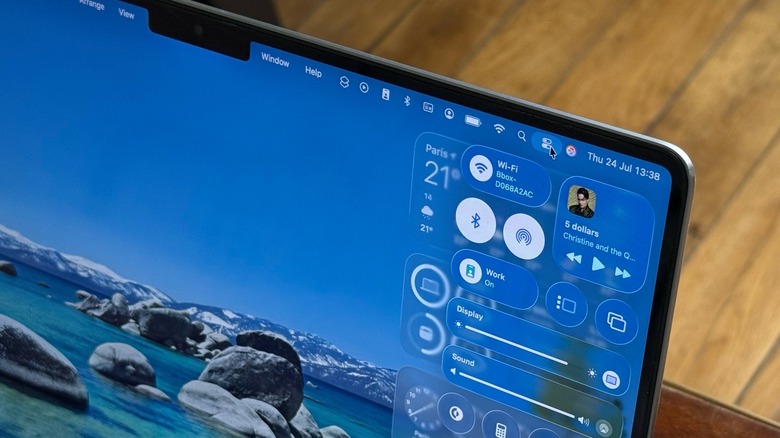
In late 2021, Apple completely redesigned the MacBook Pro. It was the first major redesign in years, and just a year after the company bet on a new, house-made processor called the M1. With new M1 Pro and M1 Max chips, more powerful variants of the first processor introduced in November 2020, the company bet on fixing the flaws of previous iterations by offering a new industrial design with enough space for thermal cooling, a better webcam, an old-new keyboard system, more ports, the return of MagSafe charging after it'd been discontinued, and a mini-LED display. These laptops remain hardware powerhouses, even as we approach their fifth anniversary. That said, if we were to buy a new MacBook Pro in 2026, what would it look like? Well, kind of the same as the 2021 model, but with a bigger focus on AI workloads, more powerful processors, and even one tweak or two on the display.
Even though Apple is expected to refresh the MacBook Pro in late 2026 or even early 2027 with an all-new design, an OLED display, and even touchscreen capabilities, one can say that the MacBook Pro has already changed a lot in recent years, despite maintaining the same chassis. In addition to Thunderbolt 5 support and a new darker color, here are some of the ways the MacBook Pro changed from 2021 to 2026, as we expect it to change a lot more soon.
Redesigned base model
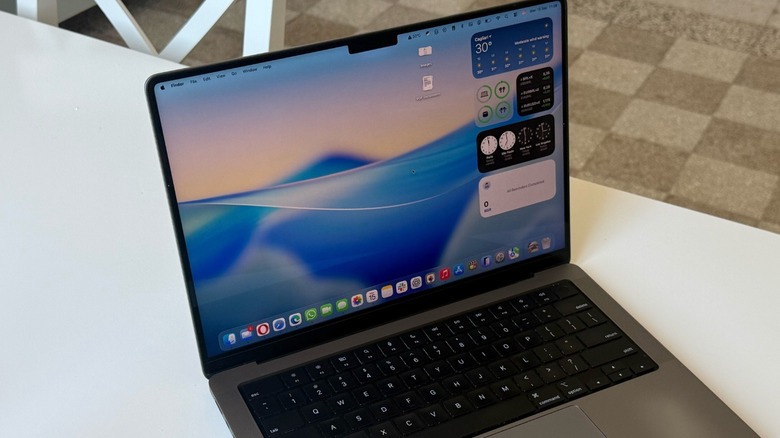
With the M3 MacBook Pro, Apple finally ditched the Intel look for the base model. With that, the company brought a more consistent visual identity among its computer lineup, as it upgraded the base model with a 14-inch display with mini-LED technology, all of the ports from the higher-end models, including the beloved MagSafe connector, and the SD card slot. The new M3 MacBook Pro also offered an improved thermal design, finally ditched the Touch Bar, and added a more capable webcam.
For $1,599, getting a proper MacBook Pro got a lot more affordable, as users had previously had to spend a few hundred dollars extra to get the new design with the Pro or Max chips. With the M3, Apple brought the redesign to a more affordable model for those who wanted a proper cooling system, a better display, and other perks that only the MacBook Pro offered.
Still, the most important part is that Apple ditched the Intel design, which was plagued by several flaws and complaints from users. For example, this laptop only had Thunderbolt ports and a headphone jack. For the Touch Bar, it always felt like an empty party, as not many developers created solutions for it, making it just a gimmick for (some of) Apple's built-in apps.
Powerful and more modern processors
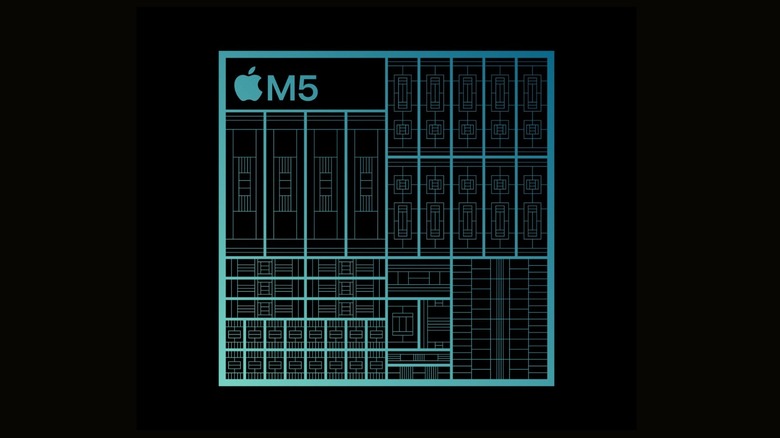
It's only natural to assume that a lot has changed with Apple Silicon processors since the introduction of the M1, and then M1 Pro and M1 Max. Four generations later, we now have the M5, M5 Pro, and M5 Max, and Apple is expected to skip the M6 chip and go straight to the M7. Basically, Apple has focused on improving multi-core processing, graphics, and AI capabilities. The M5 family introduces a new Fusion Architecture with 3-nanometer process technology that significantly increases core counts and efficiency compared to the 5-nanometer M1 series. For example, graphics performance is up to 2.5 times faster on the M5 than on the M1, and base memory bandwidth has more than doubled from 68.3 GB/s on the M1 to 153 GB/s on the M5. In addition to that, the M5 features a redesigned GPU with dedicated Neural Accelerators in every core, delivering up to six times the peak GPU compute for AI tasks compared to the M1.
With the third-generation ray-tracing engine and enhanced shader cores, the M5 family also brings significantly improved graphics performance, which makes an M5 machine a lot better for running games and graphics-related software. While the M1 chips are still very capable, it was only possible to max these computers to up to 64GB of RAM, with the base being 8GB. For the M5, users start with 16GB of RAM and can upgrade to up to 128GB of RAM in the M5 Max version, offering more room for more demanding tasks.
Improved displays
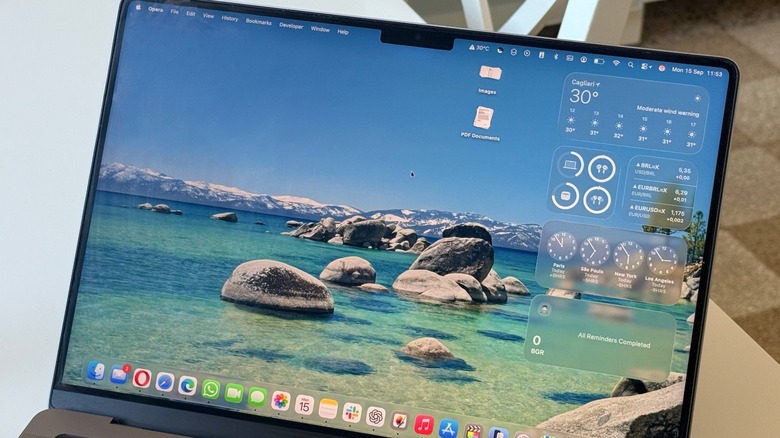
One could say that Apple has been keeping the same mini-LED panel it introduced in late 2021 in the M1 Pro and M1 Max, but it's not true. With the M4 Pro and M4 Max options introduced in late 2024, Apple updated these computers with a brighter Liquid Retina XDR display, offering up to 1,000 nits of brightness for SDR content and up to 1,600 nits for HDR content. Comparatively, the main change is that the M1 Pro MacBook Pro offers 500 nits of standard brightness, while the new M5 Pro can be twice as bright at the same battery capacity, making this computer a lot more useful outdoors.
Another noteworthy change that arrived with the M4 generation is that customers who choose the Pro or Max iterations can opt for a nano-texture display instead of the regular screen. The technology was first introduced with the Pro Display XDR, later expanded to the Studio Display and the iPad Pro. Apple says that nano-texture "dramatically reduces glare and distractions from reflections." While not every user needs to pay extra for this function, it can be a life-changing experience if you work against a source of light like a big window, if you're always working outdoors in cafes, or if glare in general annoys you. Choosing Apple's built-in option is better than adding a third-party screen protector, because there's no risk of interference between the display and the keyboard. A third-party screen protector could potentially damage the display.
Advanced video call features

When Apple revamped the MacBook Pro with a new design in 2021, it also improved the webcam by upgrading it from a 720p FaceTime HD camera to a 1080p FaceTime HD camera, thanks to a larger image sensor and a wider aperture for better low-light performance. A more advanced image signal processor, integrated directly into the M1 Pro and M1 Max chips, also provided real-time video quality enhancements.
While this was already a big boost to most Mac users, over the years Apple added software features to dramatically improve video calls even further. For example, the company started allowing an iPhone or third-party webcam to be used in favor of the built-in laptop camera, and it also added other features like Portrait, Studio Light, Background, and most recently Edge Light. Portrait brings a bokeh effect to the background, Studio Light can help glow up your face, and the Background function can add a different background image for privacy purposes. Finally, the Edge Light effect mimics a ring light on the edges of your display to make your face brighter on a call.
Besides the software improvements, which are also available for M1 computers, Apple introduced with the M4 MacBook Pro a new 12MP Center Stage camera that enhances video quality while keeping the user centered in the image as they move around. Another cool feature is Desk View, which lets you show your table in case you need to demonstrate something.
Big focus on AI
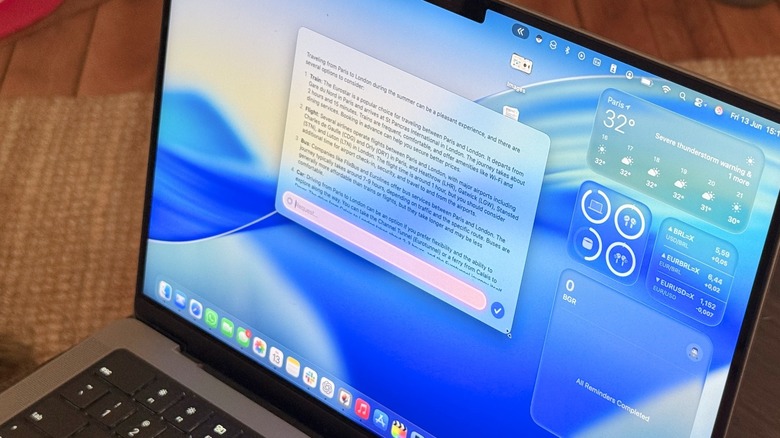
Apple announced the all-new Siri AI during the WWDC 2026 presentation on macOS Golden Gate. While the personal assistant is only a tiny part of Apple's AI strategy, what really changed in the past five years is how much the company is now focusing on AI overall. When the company introduced the M1 Pro and M1 Max chips, there was not a single mention of "AI" in Apple's press release. Instead, the company mentioned "machine learning." By the M5, M5 Pro, and M5 Max press releases, there are more than a dozen mentions of AI and zero of machine learning.
More than just representing an industry trend and a major shift for Apple, the company started to highlight how much better its Macs became for AI tasks. For example, an M5 Pro can generate images up to 7.8 times faster than the M1 Pro; LLM prompt processing is 6.9 times faster, and 3D rendering in Maxon Redshift is up to 5.2 times faster.
This is because not only did Apple create a new manufacturing process for its latest chips, but it also kept betting on improved Neural Engine cores, improved unified memory, and more. That said, while M1 Pro/Max owners can still enjoy a fairly capable computer, the new technologies offered by the latest models can make an upgrade almost overdue for those working on demanding AI workloads, as there's simply no comparison with Apple's newer chips.